
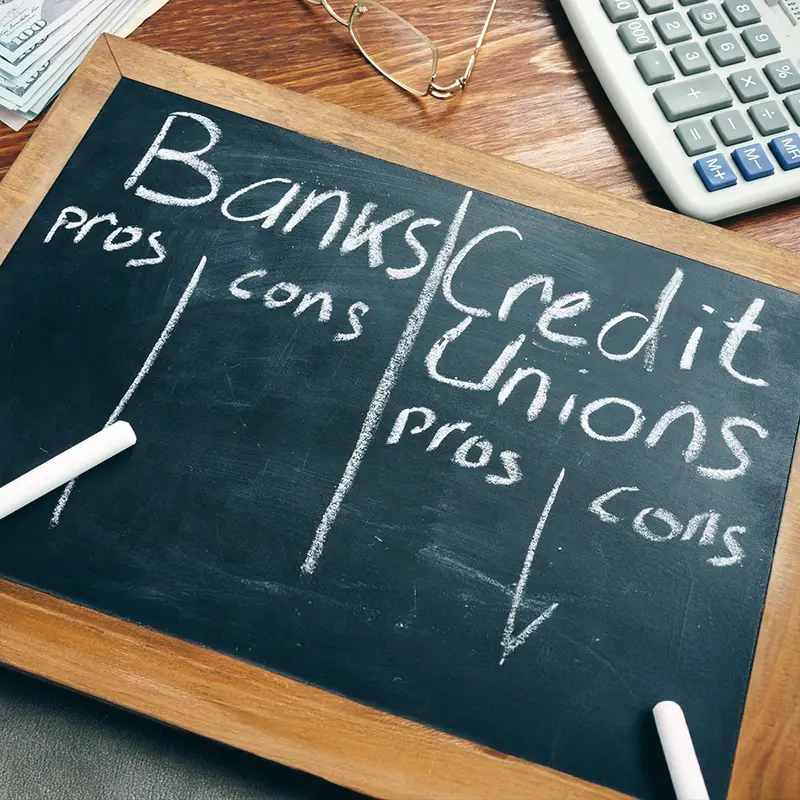

Credit unions and banks—are they just two sides of the same coin? Well, yes. And no. The differences between these two types of financial institutions aren’t exactly apples to oranges. Both can serve as smart and trusted partners when working toward your financial goals. What matters most is which features matter most to you.
How are banks and credit unions similar?
First, let’s look at the elements they have in common. As early as 2000 BC, Mesopotamian merchants were loaning grain to farmers. Supporting local business has been a common thread for both banks and credit unions from the beginning. Both are licensed to offer individuals and organizations safe places to manage their money.
From basic, free checking accounts to million-dollar business development loans, credit unions and banks offer a variety of similar services, including individual and business checking and savings accounts, home, vehicle, personal, and business loans, and credit cards. Many also work with partner companies to offer investment services and home, business, auto, and life insurance. Regardless of where you choose to deposit your money, your accounts are secured up to $250,000 by the National Credit Union Association (NCUA) or, for banks, the Federal Deposit Insurance Corporation (FDIC).
How are banks and credit unions different?
Ownership
Who owns a credit union? You do! Credit unions are non-profit cooperatives, owned by their member/customers. Focused on serving distinct communities, credit unions were originally created to meet the needs of specific groups: workers for a common employer, industry or trade union, people who live in the same location or share a faith affiliation or other “bond of association.” Today, most credit unions accept members from a variety of backgrounds or professions, and revenue is invested back into the company to benefit all members, unlike banks, where profit goes to the owners or shareholders.
As for-profit institutions, banks can be privately owned by an individual, family, or company, while publicly traded banks are owned by a group of shareholders who purchase stock in the bank and receive returns on the profit. Whether an individual or a group, owners of private banks enjoy more freedom and privacy in their decision-making, but they also assume more risk. Shareholder-owned banks are subject to far greater public oversight and government regulation.
Customer base
Credit unions and banks both serve individuals, businesses, and non-profits. While their customer bases often overlap, each type of institution offers products and services attractive to specific groups. Credit unions tend to focus on meeting the banking, savings, and borrowing needs of individuals and small-to-mid-sized businesses that fall within their membership group. With business structures ranging from a privately-owned single branch to publicly traded firms with thousands of locations, banks may serve a wide variety of customers, including individuals, organizations, small businesses, and multi-national corporations.
Accounts, features, and benefits
Because credit unions are non-profit, member-owner cooperatives, all profit is reinvested back into the institution to benefit members, not shareholders. By reinvesting in the member experience, credit unions could offer better rates, fewer fees and better service.
Because they tend to serve a broader customer base, banks typically offer a larger variety of products and services. In addition to basic checking and savings accounts, loans, and credit cards, many banks offer specialized checking accounts, credit cards, and savings plans such as health savings accounts (HSAs.) Banks will often partner with outside specialists to offer wealth management services, investment products, and insurance. Many regional credit unions will do the same. Vantage Credit Union, for example, partners with affiliated companies to offer a full range of investment services, financial planning, and home, auto, life, and business insurance.
In today’s hyper mobile world, consumers demand convenience. As for-profit enterprises, banks can be quicker to adopt the ever-expanding array of technology tools, such as online and mobile banking, mobile payment platforms, and person-to-person payment apps like Venmo and PayPal. They also tend to have more locations and a larger network of ATMs, making them a convenient option for frequent travelers and businesses with branches and employees in different regions or states.
But as more credit unions join cooperative networks like CO-OP, Allpoint, and MoneyPass, their members are gaining far greater access to banking services at branches and ATMs throughout the country. So, while banks may seem like the one-stop-shop for all your money management needs, bigger is not always better. With their higher returns on savings, lower rates on loans and credit cards, and reputation for excellent customer service, credit unions are catching up fast.
Membership matters
Better returns and lower rates and fees make credit union membership a no-brainer for millions of savvy consumers. Even so, some prospective members hesitate. “Why should I have to join an organization just to purchase their services?” they ask. Unlike warehouse clubs like Sam’s Club and Costco, credit unions do not charge annual fees, you simply pay for the services you want as you use them, just like a bank. With most credit unions, becoming a member is as easy as opening a checking or savings account or applying for a loan.
For many, membership provides a sense of community. And ultimately, it is the community aspect that sets credit unions apart. For some, membership is based on a common bond:
- Employer – Private companies and government agencies may sponsor credit unions for the employees and their families.
- Location – Some credit unions are founded to serve those who live, work, or attend a school or church in a specific community, city, or county.
- Group Affiliation – Labor unions, religious organizations, alumni associations, or other special interest groups may sponsor credit unions for their members.
- Family – Many credit unions extend membership to spouses, children, and grandchildren of members.
Today, most credit unions have broadened their membership requirements to include the general public while still offering services specifically for their core members. Vantage Credit Union, for example, was founded in 1957 as the Educational Employees Credit Union to serve educators and school administrators in the St. Louis, MO area. Today, they continue to offer their teacher-focused Legacy Checking Account. And supporting local education remains a primary focus of Vantage’s community involvement. But they proudly welcome members from all backgrounds and professions. Connect with us and see if you are eligible for membership.

HISTORY LESSON
The predecessor of the modern credit union, the first financial cooperative was founded in Slovakia in 1845. To join, members had to commit to living a moral life and agree to plant two trees in a public place every year.1
Credit unions vs banks: The numbers might surprise you
Believe it or not, the US has more credit unions than banks, although banks hold the lion’s share of assets. But, as credit unions work to combine digital technology tools with the personal service they are known for, their membership is growing rapidly. In 2025 alone, American credit unions added 2.8 million new members for a total of over 143 million.2
Given their footprint, assets, and marketing budgets, it’s not surprising that when people think of banks, they picture behemoth players like JPMorgan Chase, Bank of America, and Wells Fargo. But, like credit unions, small banks play a formidable role in the United States economy, providing mortgages, small business loans, and personal banking services in areas larger banks may not serve. While the numbers vary with every merger, acquisition, and shutdown, the US is home to approximately 4,000 small banks, 130 regional banks, and fewer than 40 megabanks.
Banks
# of operators: 3,900+
# of branches: 78,300+
Total assets: $22.5 trillion
Market share: 91.2%
Credit Unions
# of operators: 4,400+
# of branches: 22,000+
Total assets: $2.37 trillion
Market share: 8.8%

FUN FACT
Together, small banks and credit unions have done much to support the growth of start-up businesses across the United States.3 More small lending institutions mean more loans being made. With approximately 4,000 small banks nationwide, the US has more small banks than the combined number of all banks in the European Union. And that’s not including the US’s 4,400 credit unions.
Bank or credit union: Which is right for you?
As we’ve noted, banks and credit unions both offer similar products and services, and your deposits in either are insured up to $250,000. What’s best for you depends on what features matter most to you.
Rates
Because credit unions are not-for-profit, they can offer higher rates-of-return on savings accounts and lower interest rates on mortgages and auto loans—all while charging low or even no fees for basic transactions.
Product options
Banks tend to offer a wider variety of checking and savings accounts, loans, and credit cards. Credit unions are more apt to stick to the basics.
Access
With more locations, ATMs, and higher adoption of new technology, many banks have an edge when it comes to convenience. But thanks to the growth of cooperative networks, credit unions are catching up fast.
Service
Community-based and member-owned, credit unions take the lead when it comes to customer service and community involvement. In a 2025 survey by J.D. Power, credit unions rated 74 points higher than banks for customer satisfaction across all categories, including trust, people, and problem resolution.4
Credit unions vs banks: Pros and cons
CREDIT UNIONS
Pros:
– May offer better rates
– Low to no transaction fees
– Non-profit, member-owned
– Personalized customer service
– Community focused
Cons:
– Limited product options
– Fewer branches and ATMs
– Membership required
BANKS
Pros:
– Variety of product offerings
– More branches and ATMs
– More tech tools for customers
– No membership required
Cons:
– May offer less favorable rates
– Lots of fees
– Profit focused
The bottom line
The choice of who to trust with your hard-earned money is a personal one. Only you can determine whether a bank or a credit union best meets your financial needs and goals. Many consumers use both. A checking account with a bank lets you do your everyday banking when and where works best for you—in-person, online, or on-the-go through a large network of ATMs. A credit union can give you higher rates on your savings accounts, lower rates on your mortgage, and the reassuring personal service you can only get from local lending experts.
Sources:
1 Wikipedia, History of Credit Unions.
2 Quarterly Credit Union Data Summary 2025 Q1, National Credit Union Administration.
3 The U.S. has more banks than anywhere on Earth. That shapes the economy in many ways. NPR. May 9, 2023.
4 Credit unions lead banks in all seven dimensions of consumer satisfaction survey. America’s Credit Unions, April 9, 2025.